Group Practice Growth
Why a Growing Group Practice Can Still Have a Cash-Flow Gap
A healthy, growing group practice can experience cash-flow pressure precisely because it is growing. Understanding the timing mismatch is the first step to managing it.
If your practice is growing but the cash is arriving after the expenses, let's talk through what's happening before you decide what kind of capital — if any — makes sense.
Private conversation. No obligation to accept financing.

Growth and cash do not arrive on the same schedule
A practice owner hires two additional clinicians because demand is strong and waitlists are growing. That is good news for the practice and the people it serves. But over the following weeks, the owner notices the operating account is tighter than it was before the hires — even though the practice is clearly growing.
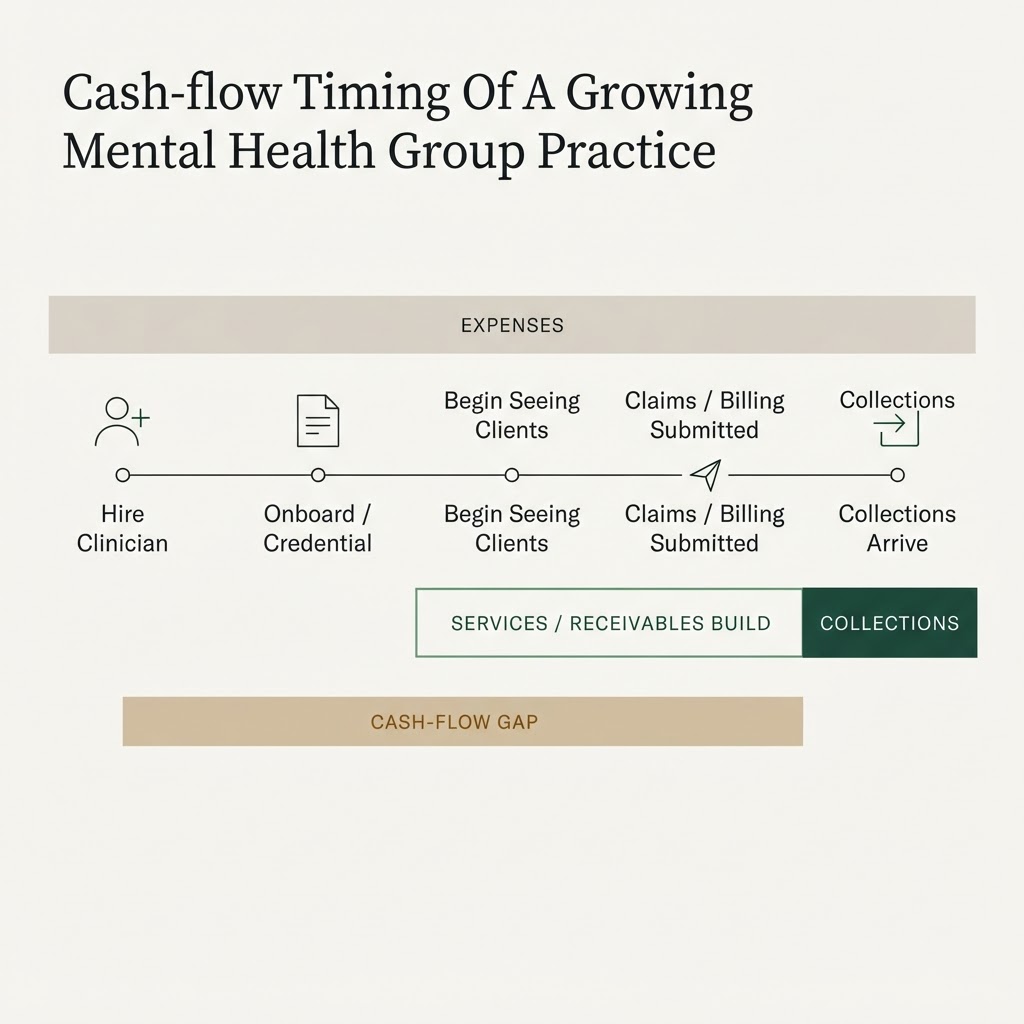
That experience is common, and it is not necessarily a sign that something is wrong. Revenue growth is measured over time. Cash availability is measured right now. A practice can be adding clinicians, adding clients, and increasing monthly collections — and still feel tighter on cash than it did when it was smaller.
The tension exists because the expenses that create future revenue tend to arrive before the revenue itself does.
Where the cash goes during growth
Several common growth moves pull cash out of the business before new collections arrive:
- People — recruiting, onboarding, licensing, training, and supervision time for each new clinician.
- Credentialing with payers, which can delay the start of in-network collections.
- Payroll and administrative support once the new clinicians begin.
- Marketing and patient-acquisition spend to fill the new clinicians' schedules.
- Infrastructure and capacity — EHR and telehealth technology, office space, and higher overall operating expenses.
Each of these is a reasonable, even necessary, part of building capacity. Together, they can create a stretch where the practice is funding tomorrow's collections out of today's cash.
If this sounds familiar
You don't have to guess at the funding path.
A short conversation can help separate a temporary growth-timing gap from a larger cash-flow issue and clarify which options are worth exploring.
Revenue growth versus cash available today
These two numbers are related, but they are not the same. Revenue growth describes the trajectory of the business over months and quarters. Cash available today describes what is actually in the account this week to meet payroll, rent, and overhead.
A practice can show strong revenue growth on paper while its operating account dips during the weeks before a new clinician's collections begin to arrive. That is a timing problem, not necessarily a profitability problem.
Key takeaway
Growth creates expenses before it creates cash.
Why this happens to healthy practices
Healthy practices often grow intentionally. They hire ahead of demand to protect quality of care and avoid long waitlists. They invest in capacity before that capacity is fully utilized.
That deliberate approach is good practice management — but it means the business is paying for tomorrow's capacity out of today's cash, and tomorrow's collections have not arrived yet.
A cash-flow gap does not automatically mean something is wrong with the practice. Sometimes the gap exists because the business is investing ahead of its next stage of revenue. What matters is that the owner understands and plans for that timing, rather than assuming future revenue will automatically solve today's cash requirements.
Questions to Ask Before Your Next Growth Move
These questions are not about whether to grow. They are about understanding the financial shape of growth before it arrives:
- What expenses will increase the moment the next clinician starts, and what expenses will increase before they start?
- How long is the gap between this clinician beginning work and their collections reaching the bank account?
- How much operating cash does the practice have to carry through that gap?
- Which of these expenses are one-time onboarding costs, and which become permanent monthly obligations?
Dr. Ronell Pugh is a behavioral marketing scholar, entrepreneur, and business advisor whose work examines how business owners make growth and financial decisions. Through Dr. Pugh | Growth Capital, he helps established businesses evaluate capital needs, timing, and growth readiness.
Want to talk it through?
Book a Funding Strategy Call
If your practice is growing faster than cash flow can comfortably support, let's talk through the timing, capital need, and available options.
No obligation to accept financing. We'll first talk through what you're trying to accomplish.
Disclaimer
This article provides general business-fundability education. Funding criteria vary by funder, industry, transaction, and current market conditions. Nothing in this article is a financing offer, approval, guarantee, legal advice, accounting advice, tax advice, or financial-planning advice.